Buyer's guide

SoilSense

Best Soil Moisture Sensor Systems for Agriculture in 2026

A side-by-side comparison of six wireless soil moisture monitoring systems — Arable, CropX, Sensoterra, Sentek, Farm21, and SoilSense — for orchards, vegetable farms, vineyards, and municipal green spaces.

Last updated: 4 June 2026

How we compared the systems

A soil moisture sensor system is more than a probe in the ground. It's a chain — sensor, datalogger, wireless link, cloud platform, mobile app, and ideally an algorithm that turns raw readings into a clear answer to “should I irrigate today?”. The choice that matters depends on which link in that chain you don't want to think about. The five criteria below are how a farmer who isn't a data engineer actually picks a system. They're also where the systems we compare here genuinely differ.

  1. Automatic calibration

    Does the system figure out this soil, this crop's field capacity and refill point on its own, or does it ship raw VWC numbers that you (or a paid agronomist) have to interpret? Peer-reviewed work on field-capacity detection algorithms shows it's possible to learn these thresholds from each field's irrigation/rain history without lab calibration — but most commercial systems still rely on factory defaults or a paid calibration service.

  2. Measurement reliability across depths

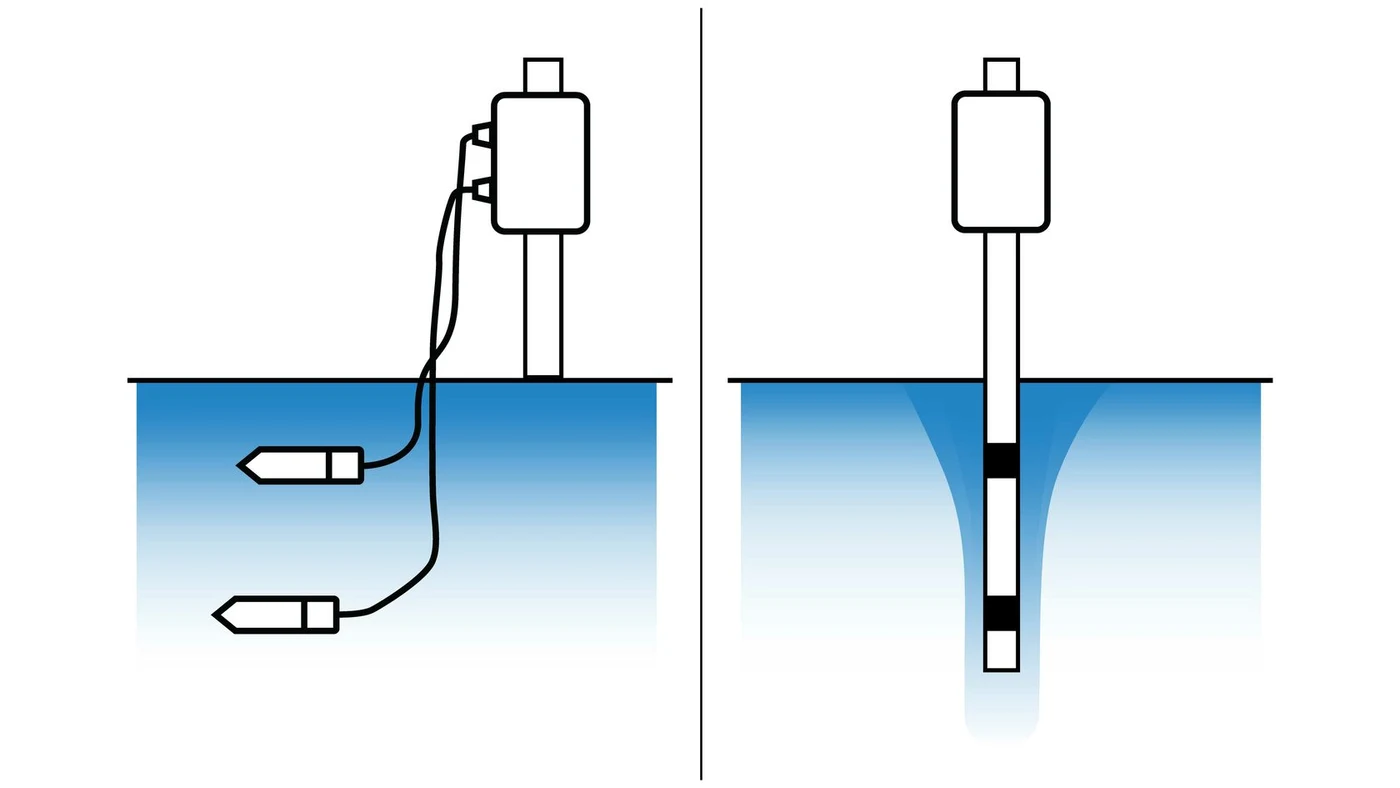
    Two things determine whether a soil-moisture reading is trustworthy: the sensor's physics and the installation geometry. SoilSense uses TDT physics (the same class as research-grade TDR) and a buried-sensor geometry — sitting on the strongest side of both axes.

    Diagram contrasting buried SoilSense sensors with stick-style probes that cause preferential water flow along the device surface.
    Buried sensors (left) measure water as it travels through the soil. Stick-style and access-tube probes (right) can channel rain and irrigation along their own surface — biasing readings high.
    Read the full methodology +

    On physics, peer-reviewed comparisons consistently place TDR/TDT-class sensors at the tightest field-accuracy band and capacitance / FDR / ADR-class sensors at ± 2-5 % VWC after factory calibration, degrading at higher salinity unless site-calibrated per sensor.

    On geometry, screw-in and access-tube probes can channel rain and irrigation water down their own surfaces (preferential flow); access-tube studies document VWC errors up to ± 5 % and irrigation-flux estimation errors up to 50 mm/day from this effect, and competing sensor maker METER Group warns in its own installation literature that profile probes are "especially susceptible to preferential-flow problems down the long surface of the access tube."

    Manufacturer accuracy specs are not always like-for-like — TDR/TDT figures tend to be absolute field accuracy, while capacitance figures often reflect lab precision or proprietary-calibration setups that don't survive independent field comparisons.

  3. Sensor breadth on one platform

    Soil moisture, soil temperature, soil salinity (electrical conductivity), and rainfall — all on a single datalogger, all on one app screen. Many systems do moisture-only and force you to stitch in a weather station, an EC probe, or a rain gauge from someone else, paying two subscriptions and reconciling two timestamps.

  4. Software & UI for a farmer, not an agronomist

    Does the app open on a phone and immediately answer “should I irrigate today?” with a clear yes/no — or does it dump a multi-line graph and expect you to interpret it? Many platforms have powerful but cluttered dashboards built for service agronomists; SoilSense is intentionally minimal.

  5. Total cost & install effort for an SME farm

    Hardware + 3-year subscription + installation labour for a typical 3-hectare orchard or vegetable block. No drilling, no auger, no gateway, no professional services contract. Many enterprise-grade systems are excellent — and unaffordable for the SME farms that make up the majority of growers worldwide.

In a hurry? Here's the short answer.

Best overall — cheapest entry + only TDR/TDT in this list

SoilSense

SoilSense — €300/year subscription bundles the datalogger, two TDT sensors, dashboard, and installation support. The cheapest published entry point in this comparison, and the only system using TDR/TDT-class sensor physics (the tightest field-accuracy class in peer-reviewed literature). 60-day risk-free trial.

Read full review

Best for large enterprises

CropX

CropX — best for irrigated row-crop and permanent-crop operations that want a mature digital-agronomy platform with VRI prescriptions, disease models, and bundled advisor workflows.

Read full review

Best for deep multi-depth research

Sentek

Sentek — best for irrigation specialists, agronomists, and research stations that need a deep root-zone profile (Drill & Drop up to 1.2 m, EnviroSCAN to 30 m+) with site-specific calibration.

Read full review

Quick comparison

Best — strongest available in this category. Strong — solid. Partial — works but with caveats. Weak — material limitation. N/A — not offered.

SystemAuto-calibrationReliabilitySensor breadthUI for farmersCost & installPricing
SoilSenseSmall-to-mid farms, orchards, vegetable growers, and municipalities that want trustworthy data without hiring an agronomist
Best

Field capacity detected automatically from each field's history.

Best

TDT sensors, ± 1 % VWC, stable across soil salinity.

Strong

Moisture + temperature + EC + rainfall on one datalogger.

Best

Daily irrigate-or-not answer, intentionally minimal.

Best

No gateway, no tools, no agronomy contract. 10-minute install.

$
ArableEnterprises, food companies, and research programmes that want weather, canopy, ET, and soil context in one rugged in-field node — especially where water-stewardship reporting matters
Partial

Calibrated weather measures, but soil calibration relies on the third-party Sentek accessory.

Strong

Up to 12 soil sensors at 10 cm spacing via the Sentek accessory.

Best

Weather, rainfall, radiation, imagery, ET, canopy, and accessory soil.

Strong

Web, mobile, and API — enterprise-oriented rather than farmer-minimal.

Weak

Contact-sales hardware + add-on soil probes; heavy for 3 ha.

$$$
CropXIrrigated row-crop and permanent-crop operations that want prescription-irrigation files for variable-rate equipment, disease/nutrition models, and an active agronomy advisor relationship
Best

Proprietary self-calibration on Vertex; auto moisture set points on Apex.

Strong

Capacitance/ADR class; 3 physical depths on Vertex, Apex profiles to 90 cm.

Strong

Soil moisture, temperature, EC, plus optional rain/weather/ET devices.

Strong

Mature app with agronomic recommendations; some advisor-grade workflows.

Partial

Vertex entry price is mid-market; full stack pushes towards enterprise.

$$
SensoterraDistributed soil moisture networks where LoRaWAN is available — integration partners, water managers, municipal/urban green, and growers who only need soil moisture trends
Strong

Soil-type calibration library plus custom calibration on request.

Partial

Multi Depth covers 6 points; Single Depth is one point and lacks EC.

Weak

Soil moisture (Single Depth) or moisture + temperature (Multi Depth) only.

Partial

Monitor app is simple; positioning is integration-first.

Partial

Hammer-in install is easy, but LoRaWAN gateway and per-device fees add up.

$$
SentekIrrigation specialists, agronomists, research stations, and orchards/vineyards/tree-crop operations that need reliable multi-depth root-zone profile data and are comfortable with dealer-supported installation
Partial

Default factory calibration + site-specific calibration per sensor.

Best

Drill & Drop up to 12 sensors; EnviroSCAN up to 16 at 10 cm intervals.

Partial

Moisture + temperature + salinity in the probe; rainfall/air via separate products.

Partial

IrriMAX is powerful but agronomist/irrigation-specialist oriented.

Weak

Hardware + telemetry + subscription + dealer install; heavy for 3 ha.

$$$
Farm21Small and medium European farms, crop advisors, and distributors that need affordable dense deployment, simple install, and a three-depth shallow soil moisture profile with microclimate context
Partial

Soil-type selection and Farm21 calibration documented; no auto-calibration claim.

Partial

Three shallow depths to 30 cm; no deeper profile.

Strong

Soil moisture + soil temp + air temp + humidity in one device; missing EC and rainfall.

Best

Positioning and pricing emphasise farmer ease, alerts, sharing, and SME affordability.

Best

Lowest steady-state per-spot ongoing cost from year 2; no gateway, simple install.

$

Detailed reviews

#1 · Denmark — founded 2017, sold across the EU

SoilSense

Wireless TDT sensors, no gateway, no tools to install, auto-calibration built in.

Best for: Small-to-mid farms, orchards, vegetable growers, and municipalities that want trustworthy data without hiring an agronomist.

SoilSense is a Danish company that builds a solar-powered wireless datalogger, TDT soil moisture sensors, and a progressive web app — installable to your phone's home screen and used exactly like a native app, with no App Store download or update prompts — that turns the data into a daily irrigation answer. Up to five sensors per datalogger; cellular connection direct to the cloud (NB-IoT, LTE-M, 2G fallback); no LoRa gateway and no auger needed to install.

What it does well

  • Cheapest published entry point in this comparison — €25/month per datalogger (annual billing) bundles the solar-powered datalogger, two TDT sensors, the dashboard, and installation support for €300/year all-in. No upfront hardware bill.
  • Only system in this comparison using TDR/TDT-class sensor physics — the tightest field-accuracy band in peer-reviewed soil-moisture literature, stable across soil texture and salinity.
  • Buried sensors don't disturb water flow — they avoid the preferential-flow bias documented in peer-reviewed work on access-tube and screw-in probe geometries (errors up to ± 5 % VWC and irrigation-flux errors up to 50 mm/day from this effect).
  • Sensors install in 10 minutes per site without tools. No LoRa gateway, no drilling, no dealer visit. Solar-powered datalogger runs year-round, AA-replaceable batteries last 2+ years.
  • Auto-calibration plus a daily "should I irrigate today" answer — no agronomist on staff, no data analyst maintaining the platform. 60-day risk-free trial backs the whole stack.

Where it falls short

  • If you need a deep multi-meter soil profile at 6+ depths, Sentek's Drill & Drop and EnviroSCAN remain the established reference. SoilSense focuses on root-zone depths (typically 20-60 cm); not the right tool for whole-profile water-balance research.
  • If your operation needs bundled on-staff agronomy services, prescription-irrigation files for variable-rate machinery, or disease/nutrition models layered on top of the sensor data, CropX is more mature.
  • If you've already standardised on a weather-station-led ecosystem (Arable Mark 3 for weather + canopy + ET) and want soil moisture inside that dashboard, adopting a separate SoilSense app is friction.
  • We're a Danish SME, not a global enterprise vendor. If your purchasing process requires a multinational supplier on a master agreement, we're not currently on most of them.
Pricing model: €25/month per datalogger, billed annually (€300/year all-in for 1 datalogger + 2 TDT sensors + dashboard + install support). Add-ons: Rain Data €7/mo, EC Data €10/mo per datalogger. 60-day risk-free trial. A separate buy-outright option starts at €399 for the datalogger.Visit vendor →See the SoilSense system →

#2 · USA — founded 2014, offices in India and Brazil

Arable

Field-station-led platform combining weather, canopy imagery, ET, and accessory soil probes in one device.

Best for: Enterprises, food companies, and research programmes that want weather, canopy, ET, and soil context in one rugged in-field node — especially where water-stewardship reporting matters.

Arable's flagship is the Mark 3 — a solar-powered in-field station that measures precipitation, air temperature, humidity, pressure, spectrometry, and crop imagery (NDVI, chlorophyll, leaf wetness, ETo/ETc, canopy temperature). Soil moisture, temperature, and salinity are accessory channels; Arable's published spec sheet lists Sentek Drill & Drop as the soil probe option, with 1, 3, 6, 9 or 12 sensors at 10 cm spacing.

What it does well

  • Broadest sensing stack in this comparison — weather, rainfall, radiation/spectrometry, crop imagery, ET, and canopy stress metrics, all in one rugged IP67 node.
  • Solid built-in cellular coverage (LTE-M and NB-IoT across most regional bands, plus 2G fallback) and a 6 W solar panel with rechargeable battery.
  • Web app, mobile app, and a documented public developer API.
  • The accessory Sentek soil probe can deliver up to 12 measurement points at 10 cm spacing — a serious multi-depth profile.
  • Enterprise-grade hardware, support model, and integrations suited to large agribusinesses.

Where it falls short

  • Soil moisture is not built into the base Mark 3 — it depends on an auxiliary Sentek probe purchased and installed separately.
  • Pricing is on quote; the product CTA is "Request a Demo" / "Contact Sales". Likely too high in total cost for a 3-hectare SME farm.
  • Soil calibration on Arable is inherited from the third-party Sentek accessory; there is no Arable-owned automatic calibration workflow for soil sensors.
  • Powerful agronomic outputs are derived/modelled, which is great for service teams but less transparent for farmers who want simple raw soil thresholds.
  • Two-piece install (station + soil probe) is heavier than a single push-in probe if soil profile data is what you need.
Pricing model: Quote-based, enterprise hardware + platform subscription.Visit vendor →

#3 · Israel / USA / New Zealand — founded 2013, moved HQ to Israel 2017

CropX

Multi-depth screw-in soil probe with proprietary self-calibration and a mature digital-agronomy platform.

Best for: Irrigated row-crop and permanent-crop operations that want prescription-irrigation files for variable-rate equipment, disease/nutrition models, and an active agronomy advisor relationship.

CropX sells the Vertex 4 multi-depth screw-in probe (3 physical depths plus virtual readings every 10 cm down to 66 cm) and the Apex 1 access-tube-style probe (10 cm resolution to 30, 60, or 90 cm) paired with the CropX agronomic platform. Vertex measures VWC, EC at all 3 depths, and temperature at the top two depths. Optional Strato weather station, Rivo rain gauge, and Evato ET sensor complete the system.

What it does well

  • Auto-calibration is a documented CropX feature — Vertex's hardware page calls it auto-calibration and the V4 brochure describes "a proprietary self-calibration method" with automatic soil water budget line detection.
  • Broader platform beyond soil moisture — ET, rainfall, weather, disease pressure, satellite imagery, and VRI prescription outputs.
  • Vertex is self-contained (built-in telemetry and battery, no separate datalogger); Apex covers deeper multi-depth profiles when needed.
  • Public store pricing exists for at least the US channel — Vertex V4 sensor lists at $695 + $300 platform subscription.

Where it falls short

  • Full breadth requires multiple hardware products (Vertex + Apex + Strato + Evato + Rivo), not one low-cost probe — total cost rises quickly.
  • Apex requires a separate CropX Telemetry device for cellular connectivity.
  • The platform leans agronomist/advisor-oriented; some workflows reward expertise more than they reward a 5-minute farmer glance.
  • Vertex has 3 physical sensing depths; a deeper, true 10 cm-resolution profile means moving up to Apex.
  • Vertex's screw-in geometry creates a continuous device surface between the soil top and the sensors below — the same shape that can channel rain and irrigation water down the probe (preferential flow) and bias root-zone readings high. Install is also drill/screw rather than push-in.
Pricing model: Vertex V4 ~$695 hardware + $300/yr subscription at public US pricing; full enterprise stack on quote.Visit vendor →

#4 · Netherlands — established 2015, headquartered in Houten

Sensoterra

Hammer-in LoRaWAN soil moisture probes with a cloud calibration library for 20+ soil types.

Best for: Distributed soil moisture networks where LoRaWAN is available — integration partners, water managers, municipal/urban green, and growers who only need soil moisture trends.

Sensoterra makes hammer-in LoRaWAN soil probes in two shapes: Single Depth (15, 30, 60, or 90 cm lengths, one measurement point) and Multi Depth (six measurement points at 10/20/30/45/60/90 cm, plus temperature). Built-in lithium batteries last 6-10 years. Sensoterra positions itself as an API-first measurement layer that other dashboards integrate.

What it does well

  • Genuinely hammer-in install — no auger, no drilling, no tools. Among the fastest field deployments in this comparison.
  • Long battery life — Single Depth 6-10 years on a non-replaceable internal cell; Multi Depth 7-10 years.
  • Cloud calibration library covering 20+ standard soil types, with custom calibration available on request.
  • API-first platform — REST API, SenML HTTP push, GeoRSS feed, plus a Sensoterra Monitor web/mobile app.
  • Multi Depth gives a real six-point profile down to 90 cm in a single probe.

Where it falls short

  • Core probes are narrow: Single Depth is soil moisture only; Multi Depth adds temperature but no EC or rainfall.
  • LoRaWAN gateway/coverage is a deployment dependency — if you're not on a public LoRaWAN network and don't want to install a gateway, this is friction.
  • Sensor technology is impedance-based (Sensoterra's own wording — patented combination of resistivity and capacitance), falling in the capacitance/FDR class for which peer-reviewed field comparisons document typical ± 2-5 % VWC after factory calibration, with site-specific calibration needed to tighten that further.
  • Built-in battery is generally non-user-replaceable; end-of-life means refurbishment or replacement.
  • Production pricing is quote-based; only pilot package prices are public.
Pricing model: Pilot packages from €999 (1 Single Depth) to €4,999 (4 Multi Depth); production on quote.Visit vendor →

#5 · Australia — founded 1991, HQ in Stepney, South Australia

Sentek

Deep multi-depth soil profile probes (Drill & Drop, EnviroSCAN) with site-specific calibration and the IrriMAX analytics platform.

Best for: Irrigation specialists, agronomists, research stations, and orchards/vineyards/tree-crop operations that need reliable multi-depth root-zone profile data and are comfortable with dealer-supported installation.

Sentek has been building capacitance (FDR) soil profile probes since 1991. Drill & Drop is the fully encapsulated 30-120 cm probe with sensors every 10 cm (1, 3, 6, 9, or 12 sensors), measuring moisture, temperature, and optional salinity. EnviroSCAN is the company's flagship deep-profile system: 0.5 to 30 m, up to 16 sensors at 10 cm intervals via dedicated access tubes. Data lands in the IrriMAX desktop application or the IrriMAX Live subscription portal.

What it does well

  • Deepest and most flexible soil profile measurement in this comparison — EnviroSCAN reaches well beyond standard root-zone depths.
  • Sensors every 10 cm across the full probe length — true high-resolution multi-depth profiling.
  • Multi-channel: moisture, temperature, and salinity at each depth (with humidity options on EnviroSCAN).
  • Site-specific calibration is explicitly supported — each individual sensor can take its own calibration equation.
  • 30+ years of track record, established global dealer network, and standard logger protocols (RS232, RS485, SDI-12, Modbus) for third-party integration.

Where it falls short

  • Installation is more involved — EnviroSCAN requires customised 56.5 mm access tubes and specialised installation tooling. Sentek's own documentation calls for a soil-slurry technique on install to seal the device against the surrounding soil; without it, the access-tube wall can become a preferential-flow channel that biases readings high.
  • Wireless/cloud setup typically requires a separate Sentek DTU (PLUS/MULTI) plus IrriMAX Live subscription rather than a single self-contained probe.
  • Probes are capacitance (FDR) — the 2024 Sensors peer-reviewed comparison documented capacitance accuracy drift at higher soil salinity unless site-calibrated per sensor.
  • IrriMAX is powerful but oriented toward irrigation analysts and agronomists, not a five-second farmer glance.
  • Total system cost (probe + telemetry + subscription + install tools) is in the upper tier; rarely justified at 3 ha unless the crop value is high.
Pricing model: Dealer-quoted hardware + telemetry + IrriMAX Live subscription + installation tooling.Visit vendor →

#6 · Netherlands — founded 2017 (project), separate business 2018

Farm21

Low-cost cellular soil + microclimate probe with shallow 0-30 cm profile and transparent public pricing.

Best for: Small and medium European farms, crop advisors, and distributors that need affordable dense deployment, simple install, and a three-depth shallow soil moisture profile with microclimate context.

Farm21 builds the FS21 — a two-piece sensor with a soil moisture probe (0-10, 10-20, 20-30 cm) inserted into the ground and a main module that stays above ground measuring air temperature and humidity. Cellular built in (NB-IoT, LTE-M, 2G with SIM included) and platform/API access bundled. Recent localised pages reference an FS31 generation, but FS21 remains the documented product on the public spec sheet.

What it does well

  • Cheapest steady-state per-spot ongoing cost in this comparison from year 2 onward — €89/year per FS21 unit covers one measurement spot with three shallow depths plus microclimate channels. (Year-1 entry of €464 per spot is still above SoilSense's €300 subscription, which bundles the datalogger plus two TDT sensors.)
  • Built-in cellular with SIM and no gateway requirement — NB-IoT, LTE-M, and 2G fallback claimed across 140+ countries.
  • Multiple channels in one cheap probe: soil moisture at three shallow depths, soil temperature at two depths, air temperature, and air humidity.
  • USB-C rechargeable battery (5500 mAh) and simple above-ground install with QR-code registration.
  • Platform bundles scouting, weather, satellite, and crop layers with Excel export and API access.

Where it falls short

  • Soil sensor technology (TDR/TDT/capacitance/FDR) is not publicly disclosed on Farm21's spec sheet or FAQ — independent accuracy prediction from established sensor-class norms in the peer-reviewed literature isn't possible.
  • Only shallow 0-30 cm profile in FS21 — no deeper root-zone option for tree crops or vines.
  • No EC/salinity or rainfall measurement on the sensor itself.
  • Annual USB-C charge required — less hands-off than multi-year sealed LoRa probes.
  • Sensor must remain partly above ground (the main module is not buried), which can create a management or machinery-clearance issue in some crops.
Pricing model: €375 one-time + €89/year per FS21 unit (public EU pricing). Lowest steady-state per-spot ongoing cost in this comparison from year 2 onward.Visit vendor →

How to choose

Match the priority that matters most to your operation to the system that's strongest there. None of these are bad systems for the right buyer — they're just designed for different priorities.

  • If your priority is accurate, trustworthy data without paying for calibration services

    Look at SoilSense. TDT sensor physics and auto-calibration mean you don't need to ship soil samples to a lab or hire an agronomist to set thresholds.

  • If your priority is a mature digital-agronomy platform with VRI prescriptions and disease models

    Look at CropX. Vertex's auto-calibration is real, the platform is built for advisors managing many fields, and prescription-irrigation output is first-class.

  • If your priority is the lowest published year-1 entry price with research-grade sensor accuracy

    Look at SoilSense. The €25/month subscription (€300/year) bundles a datalogger + 2 TDT sensors + dashboard + installation support — the cheapest published entry point in this comparison and the only TDR/TDT-class sensor in the list.

  • If your priority is the lowest steady-state per-spot ongoing cost and you can live with fixed shallow depths

    Look at Farm21. €89/year per FS21 unit (from year 2) is the cheapest steady-state per-spot ongoing cost in this comparison, in exchange for a fixed 30 cm depth ceiling, no EC, no rainfall, and undisclosed sensor technology.

  • If your priority is push-it-in-and-walk-away install on a LoRaWAN network

    Look at Sensoterra. Hammer-in probes, 6-10 year batteries, and an API-first platform — just make sure LoRaWAN coverage or a private gateway is in place.

  • If your priority is a deep multi-meter soil profile or irrigation-analyst tooling

    Look at Sentek (Drill & Drop, EnviroSCAN). Different product class — sensors every 10 cm across the probe length, site-specific calibration, and the IrriMAX analytics environment.

  • If your priority is weather, ET, canopy imagery, and crop-stress models with soil as one accessory

    Look at Arable Mark 3. Built around the field-station rather than the soil probe — the broadest sensing stack here, sold to enterprises.

Frequently asked questions

Common questions from growers, agronomists, and municipal landscape managers evaluating a soil moisture sensor system.

Turn this comparison into a decision

10 questions to ask before you buy a soil moisture sensor

Take this list to any sensor vendor. Every row is something we checked across the six systems above — from each vendor's own public spec sheets and the peer-reviewed sensor literature — and the difference between a research-grade soil measurement and a marketing brochure usually shows up in two or three of them. SoilSense ticks all ten.

  1. TDR / TDT-class sensor physics

    Peer-reviewed comparisons place TDR/TDT as the tightest field-accuracy class. Capacitance/FDR/ADR drifts to ± 2-5 % VWC and worsens with salinity unless site-calibrated per sensor.

    Your current system
    SoilSense
  2. Buried sensor — no preferential flow

    Stick-style, screw-in, and access-tube probes can channel rain and irrigation along their own surface. Peer-reviewed work documents up to ± 5 % VWC bias and 50 mm/day flux errors from this geometry.

    Your current system
    SoilSense
  3. Auto-calibration from your field's own history

    Field capacity and refill thresholds detected from your irrigation/rain time-series — no soil samples to a lab, no paid agronomist to set per-soil thresholds.

    Your current system
    SoilSense
  4. Cellular built-in, no LoRa gateway

    NB-IoT / LTE-M / 2G direct to the cloud means no gateway hardware to install, power, mount, or maintain — and no LoRaWAN coverage dependency.

    Your current system
    SoilSense
  5. Push-in install in about 10 minutes per site

    No auger, no drill, no soil-slurry technique, no dealer site visit. You can deploy the system yourself in the time it takes to walk the field.

    Your current system
    SoilSense
  6. Moisture + soil temperature + EC + rainfall on one device

    One datalogger, one timestamp, one app screen. No weather-station-plus-soil-sensor patchwork, no second platform to reconcile.

    Your current system
    SoilSense
  7. Configurable depth placement, not capped at 30 cm

    Tree crops, vines, and deep-rooted vegetables need readings well below 30 cm. A fixed shallow ceiling makes the data unusable for those crops.

    Your current system
    SoilSense
  8. Farmer-friendly UI — daily "should I irrigate today?" answer

    A phone-readable yes/no, not a multi-line graph that needs an agronomist or service consultant to interpret. One person, one screen, one decision.

    Your current system
    SoilSense
  9. Public, predictable pricing — no "contact sales"

    €25/month per datalogger, billed annually, with every add-on (Rain Data, EC Data) priced on the page. No surprise dealer markups, no enterprise quote dance.

    Your current system
    SoilSense
  10. 60-day risk-free trial

    Full refund if the system doesn't earn its keep on your fields. Vendors that won't stand behind their own data quality don't offer this.

    Your current system
    SoilSense

Of the six systems in this comparison, SoilSense is the only one that meets all ten criteria. Each row is sourced from vendor product pages, peer-reviewed sensor literature, and Farm21's own published competitor article — full citations live in the methodology section above.

Let's talk

Want to see SoilSense on your soil?

Try the system risk-free for 60 days on your own fields. We'll help with sensor placement and walk you through the platform — no contract required.

Start a 60-day risk-free trial

No commitment · We respond within one business day

Or stay in the loop

Occasional updates on product releases and the latest in agricultural technology.