
October 28, 2026
Avocado Irrigation with Soil Moisture Sensors: How to Read VWC and Avoid Root Rot
Avocado roots suffer in waterlogged soil, and the tree drops fruit when the soil runs dry. Here is how to read volumetric water content (VWC) to keep an avocado orchard between the two, with the research behind each step.
Most fruit trees forgive the odd sloppy irrigation. Avocado forgives very little. Researchers describe it as "particularly sensitive to either an excess or a lack of water" (Durán Zuazo et al., 2021). Its feeder roots crowd into the top layer of soil, they have few root hairs, and they need plenty of air. A few days of saturated soil can damage them and open the door to Phytophthora root rot. Let the soil run dry instead and the tree drops young fruit, and the fruit it keeps stays smaller. If your water carries salt, there is a third limit, because avocado is particularly sensitive to salinity.
So an avocado tree does well only inside a narrow band of soil moisture, and that is why soil moisture readings pay off so clearly in this crop. A sensor that measures volumetric water content (VWC) in the root zone shows you where the soil sits inside that band and how fast it is leaving it. This guide covers what to look for in the readings, where to place the sensors, and how to turn the numbers into irrigation decisions through the season. The research behind each point is collected at the end.
Why avocado has so little room for error
Shallow roots with few root hairs
Most of an avocado's feeder roots sit in the top 60 cm of soil (Carr, 2013). In a five-year drip trial on Crete, 72% of the root system was in the upper 50 cm (Michelakis et al., 1993), and University of California advisers put 80–90% of feeder root length in the top 20–25 cm (Bender & Faber, 2015). A shallow root zone holds a small reserve of water, so in summer it doesn't take long to run down.
The roots aren't built for drying soil either. In the words of the UC growers' handbook, "the feeder roots are rather inefficient at water absorption because they have very few root hairs" (Bender & Faber, 2015).
Wet soil cuts off the roots' air
Roots breathe, and the air they use sits in the soil pores that water doesn't fill, so every extra point of VWC comes out of that air. Avocado copes with this worse than most trees. It is counted among the species most sensitive to low oxygen at the roots (Doupis et al., 2017), and flooding can damage its roots even when no disease is present (Carr, 2013).
Chilean researchers have put a number on it. When air fills less than about 17% of the soil volume, oxygen reaches the roots too slowly (Gil et al., 2012), and at that rate of supply avocado roots stop growing and, if it lasts, existing roots deteriorate (Valoras et al., 1964). The 17% figure works best as a warning level. In the same study, trees in heavy soils that stayed close to it all season grew less than trees in airier soils, even though oxygen never became limiting (Gil et al., 2012).
Phytophthora root rot thrives in wet soil
Phytophthora root rot "is the most serious and important disease of avocado worldwide", and it "thrives in areas of excess soil moisture and poor drainage" (UC IPM). The timing is short. The UC growers' handbook warns that "as little as three days under saturated conditions can predispose roots to attack by P. cinnamomi" (Menge, 2015).
Wet soil and root rot also make each other worse. In one study, root rot had little effect on photosynthesis until it reached half the root system. With seven days of flooding, rot on just 20% of the roots was enough to cut photosynthesis sharply, while the same flooding left healthy trees unaffected (Schaffer & Ploetz, 1989). UC's guidelines call appropriate irrigation "the single most critical practice for improving tree health and managing root rot" (UC IPM).
Dry soil costs fruit
Water stress doesn't stop an avocado from flowering, but it costs fruit afterwards. In 'Hass' trees grown in large containers, irrigation treatments had little effect on flowering or fruit set, but trees under water stress shed more young fruitlets, and yield fell (Silber et al., 2012). In a three-year trial on terraced 'Hass' orchards, trees given 75%, 50% and 33% of their estimated water needs yielded 43.8, 38.3 and 31.6 kg per tree, against 47.5 kg with full irrigation, and fruit size fell with them (Durán Zuazo et al., 2021). The UC handbook is blunt about it: "Missing a series of irrigations for one to two weeks may initiate fruit drop in trees and ruin the production for that year" (Bender & Faber, 2015).
Salt adds a third limit
Avocado "is very sensitive to NaCl stress", and its roots react before its leaves: at a modest salt level, root elongation fell 43% while leaf biomass fell 10% (Bernstein et al., 2004). In a multi-year field trial on mature 'Hass' trees, yields started to fall once the average salinity of the irrigation water, rain included, went above 0.57 dS/m, and dropped 65% for every further dS/m (Oster et al., 2007).
"Leaching with extra water is the only way to reduce salt accumulation in the root zone" (Bender & Faber, 2015), and extra water is exactly what the root rot risk tells you to be careful with. Doing both well takes a reading of the root zone.
What VWC readings show you
VWC is the share of the soil's volume taken up by water: a reading of 30% means 30 litres of water in every 100 litres of soil. On its own the number says little. It becomes useful against two reference lines for your soil:
- Field capacity is the level the soil drains back to after a thorough soaking, once gravity has pulled the excess down. Above it, water is filling pores that should hold air. For avocado roots, that is the "too wet" zone.
- The refill point is the level you don't want the root zone to drop below. When the reading reaches it, irrigate.
The space between the two lines is the water the tree can use without stress, your soil's plant-available water. For avocado, UC advisers suggest irrigating once about 30% of it has been used in coarse soils, and about 50% in heavier soils (Bender & Faber, 2015). In heavy, poorly aerated soils in Chile, using up to 60% before irrigating did not affect the trees' water status or yield (Ferreyra et al., 2014).
VWC-based scheduling has been tested on avocado directly. In central Chile, researchers irrigated mature 'Hass' trees with a VWC probe, keeping the root zone between field capacity and the "breaking point", the level at which the soil starts drying more slowly, a sign that the roots are finding water harder to take up. Trees that got 29% less water than the probe-managed ones, and often reached the breaking point, showed no significant loss of fruit size or production (Beyá-Marshall et al., 2022).
Both lines depend on your soil, so there is no single correct VWC figure for avocado. The SoilSense app finds field capacity and the safe range from the readings themselves after a few wetting and drying cycles, and shows each zone in one of four states: too wet, just right, getting dry or stressed.

1. The daily staircase means the roots are working
On a sunny day the reading steps down while the tree transpires, then holds flat through the night. Clear steps at 25 cm tell you the feeder roots at that depth are taking up water. The size of each step is the tree's daily draw from that layer. It grows with heat, wind and canopy size, and it shrinks on cloudy days and as the soil nears the breaking point.
The steps can also warn you about the roots themselves. A tree that is losing feeder roots drinks less, so the soil under it dries more slowly. UC lists this among the signs of root rot: "Foliage is wilted even when soil under diseased trees is wet" (UC IPM). If the steps under a block shrink over a few weeks of similar weather while the soil stays wetter, dig and look at the feeder roots.
2. A good irrigation drains back to field capacity quickly
After an irrigation the reading jumps, then falls back to field capacity as the excess drains. In most soils that takes a few hours, and up to a day or so in heavy clay. If the reading stays above field capacity much longer, you applied more water than the root zone can hold, or the soil below is not draining.
The 50 cm sensor is your second check. A normal irrigation should move it only a little. If the deep reading jumps after every irrigation, water is going past most of the roots: you are paying to pump water, and the fertiliser in it, out of reach, and keeping the lower root zone wet for no gain. With salty water, a small rise down there is what you want, as the season section below explains.
3. Two days above field capacity is the warning sign
Pattern 3 is the one to watch for in avocado. Rain on top of a scheduled irrigation, or long irrigations on heavy soil, can keep the root zone saturated for days, and three days is enough to leave roots open to Phytophthora (Menge, 2015). The steps flatten too, mostly because rainy, overcast days cut the tree's water use. If they stay flat after the sun returns while the soil is still wet, check the roots. UC's advice fits this pattern exactly: "Do not water soil that is already wet because it will become waterlogged and accelerate disease" (UC IPM). Hold the next irrigation until the reading is back below field capacity and the steps have returned, whatever the calendar says.
Where to put the sensors in an avocado block
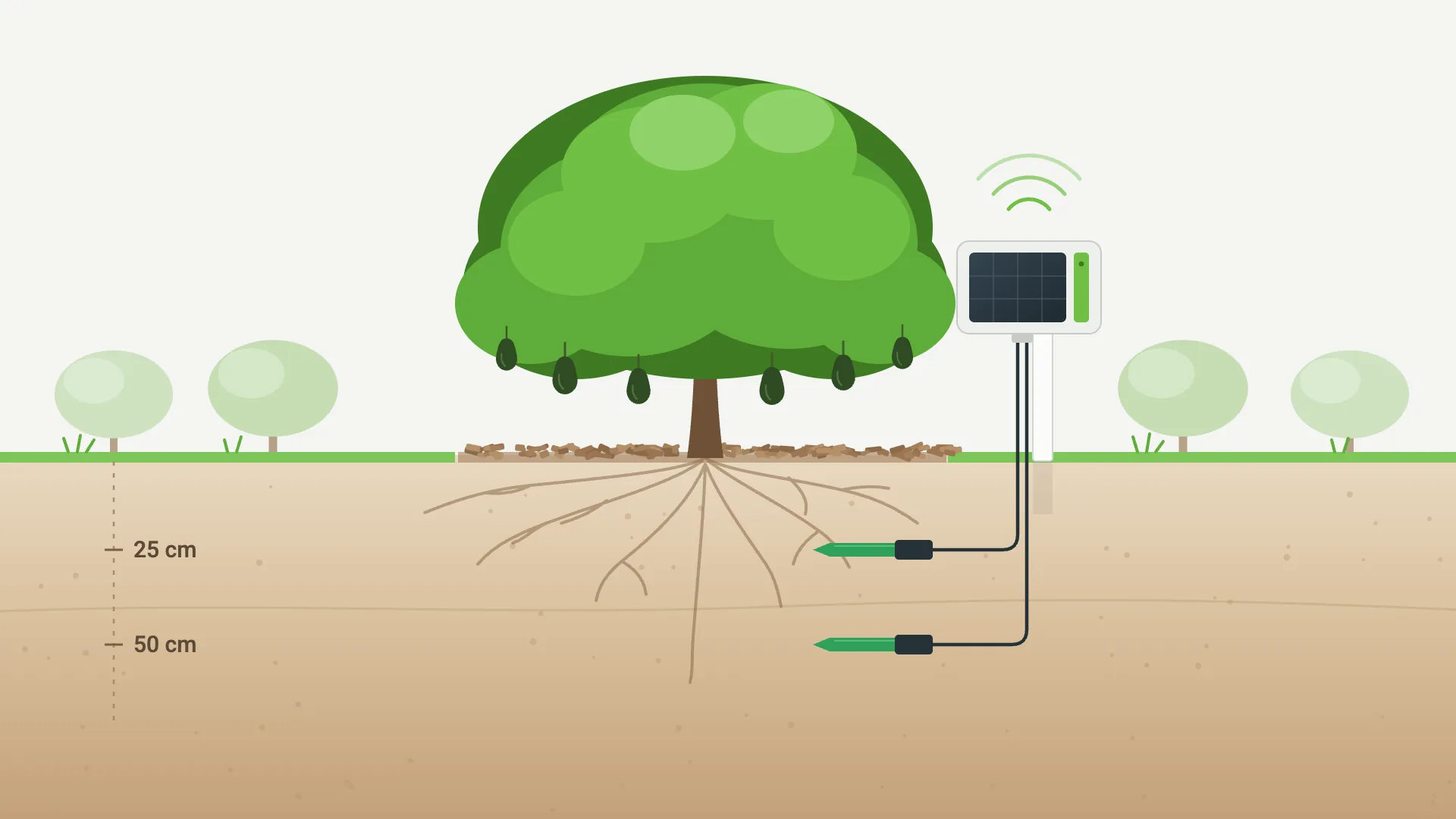
- Depth. Put one sensor at about 25 cm, among the feeder roots, and one at about 50 cm, near the bottom of the main root zone. The shallow sensor tells you when to irrigate, and the deeper one tells you whether you overdid it. UC guidance works the same way, with a shallow instrument to start irrigation and a deeper one, around 60 cm on shallow soils, to show when to stop (Bender & Faber, 2015). In deep soils, where roots go further down, the deep roots option adds a third sensor at about 80 cm.
- Roots first. Root depth changes with soil and irrigation. Under micro-sprinklers in Chile, roots in coarse soils were densest within 30 cm of the trunk and in the top 25 cm, while in fine soils they were densest about 2 m from the trunk and 50–60 cm deep (Salgado & Cautín, 2008). Dig a small pit under a representative tree and put the sensors where the roots are.
- Position. Under the canopy, inside the area your drippers or micro-sprinklers wet, because that is where the feeder roots are. Avoid the spot right under an emitter and the base of the trunk. In very stony ground, pick a spot where the sensors sit in soil rather than gravel.
- Tree. Pick a healthy tree that represents the block: same soil, same irrigation valve. One station per valve or soil type is the usual starting point. If part of a block has a history of root rot, a second station in its lowest, wettest corner shows you when that corner needs a different schedule.
- Mulch. Many avocado growers keep a thick layer of coarse wood-chip mulch under the trees, because roots that grow into it are less infected by Phytophthora (Downer et al., 2001). Mulch also slows drying, and the UC handbook warns that "it is easy to over-water mulched trees" (Menge, 2015). Count sensor depth from the soil surface under the mulch.
- Installation. SoilSense sensors are flat blades pushed sideways into the undisturbed wall of a small hole, so there is no probe shaft for water to run down and skew the reading (why that matters). Setting up a station takes about 20 minutes.
In Chile, Felipe Rodríguez grows walnuts, avocados and strawberries at Agricola Santa Inés. After ten years with soil probes that took training to read, he moved the farm to SoilSense, and his team now gets irrigation alerts on WhatsApp.
Turning readings into decisions through the season
Flowering and early fruit growth. This is when stress turns into fruit drop, so keep the 25 cm reading in the just-right band. Spring soils are often still wet from winter, so let the reading decide when the season's first irrigation goes on.
Fruit growth and summer heat. The daily steps get bigger and the soil reaches the refill point sooner, so irrigations come closer together. Give enough to bring the 25 cm reading back to field capacity without a big jump at 50 cm every time. If a heat wave is forecast, irrigate so that it finds the root zone near field capacity.
Autumn and winter rain. Rain on top of a scheduled irrigation is how most blocks end up waterlogged. When rain has already covered an irrigation, the SoilSense app tells you, so you can skip it.
Salty water. Salt builds up in the root zone unless water moves through it. UC advisers suggest leaching a little with every irrigation, by applying some water beyond what the trees use (Bender & Faber, 2015). The readings show whether that is working. A short rise at the 50 cm sensor after irrigation means water is moving through the root zone, and a Moisture + Salinity Station adds a salinity (EC) reading next to moisture, so you can see whether salt is building up. If salinity keeps climbing, the trees need more leaching water. If the deep sensor stays wet between irrigations, you are leaching far more than you need. Compare salinity readings at similar moisture levels, for example the morning after each irrigation, because the reading rises when the soil is wetter. More in why measure EC in soil.
Frequently asked questions
How often should I water avocado trees?
There is no fixed interval. It depends on soil, weather, tree size and the irrigation system, and it changes through the season. Irrigate when the reading at about 25 cm reaches your soil's refill point, which UC advisers place at roughly 30–50% of the plant-available water used, and apply enough to bring it back to field capacity. In summer heat on drip, that can mean irrigating every day or two; in mild weather, much less often.
What is the right soil moisture level for avocado?
There is no single VWC figure that suits every orchard, because field capacity and the refill point depend on soil texture. Sandy soils hold far less plant-available water than loams or clays. As one example, in a loam orchard with a field capacity of about 28% VWC, good management held the root zone at an average of 23.5% (Montazar & Faber, 2024). Keep the root zone between your own soil's field capacity and refill point, which a sensor can find from a few wetting and drying cycles.
Can overwatering kill an avocado tree?
Yes. Saturated soil damages avocado roots even without disease, and it is the condition in which Phytophthora root rot thrives. Trees with root rot "will decline and often die either rapidly or slowly" (UC IPM).
How deep should soil moisture sensors go in an avocado orchard?
About 25 cm, among most of the feeder roots, and about 50 cm, near the bottom of the main root zone. Roots sit shallower in coarse soils and deeper in fine ones, so check with a small pit first. In deep soils, add a third sensor at about 80 cm.
Should I use tensiometers or VWC sensors for avocado?
Both work. Most published avocado guidelines give trigger values as soil tension (centibars) from tensiometers, and VWC probes have been used successfully to schedule 'Hass' irrigation as well (Beyá-Marshall et al., 2022). Tensiometers read how hard the soil holds its water; VWC sensors read how much water there is. VWC makes it easy to see how much water an irrigation added and when the soil is above field capacity, and SoilSense converts it into plant-available water so you don't have to interpret raw numbers. See matric potential vs volumetric water content for the trade-offs.
What the research says
The points above rest on peer-reviewed studies and university extension guidance. Every quote is from the source itself.
Reviews and growers' guides
- Carr, M.K.V. (2013). The water relations and irrigation requirements of avocado (Persea americana Mill.): a review. Experimental Agriculture 49(2):256–278. — "The majority of feeder roots are found in the top 0.60 m of soil and root extension can continue throughout the year." · "Soil flooding and the resultant reduction in oxygen level can damage roots even in the absence of root rot." · "Avocado is particularly sensitive to salinity, notably that caused by chloride ions." doi.org/10.1017/S0014479712001317
- Bender, G.S. & Faber, B.A. (2015). Irrigation. In: Avocado Production in California: A Cultural Handbook for Growers, 2nd ed., Book Two. UC Cooperative Extension San Diego County and California Avocado Society. — "Avocado is a challenge to irrigate properly because it has a shallow feeder root system (80 – 90% of the feeder root length is located in the upper 8-10 inches of rootzone soil)." · "A rule of thumb is that irrigation timing should occur when about 30% - 50% of water available to the plant has been depleted from the soil." · "In shallow hillside soils, a tensiometer set at 8 inches deep in the soil is used to tell when to turn the system on (when cb = 20-25), and a deeper tensiometer set at 2 feet deep will tell when to turn it off (when cb = less than 10)." · "Leaching has not been well-researched in avocados, but we believe that growers should leach every irrigation by adding extra water above the 100% ETc requirement." ccfruitandnuts.ucanr.edu
- Menge, J.A. (2015). Strategies for control of avocado root rot. In: Avocado Production in California, 2nd ed., Book Two. — "As little as three days under saturated conditions can predispose roots to attack by P. cinnamomi." · "Since the mulch reduces water loss, it is easy to over-water mulched trees and thus eliminate much of the beneficial effects that the mulch produces." ccfruitandnuts.ucanr.edu
- Eskalen, A. & Faber, B.A. (2016). UC IPM Pest Management Guidelines: Avocado. Phytophthora Root Rot. UC ANR Publication 3436. — "Phytophthora root rot is the most serious and important disease of avocado worldwide." · "Root rot thrives in areas of excess soil moisture and poor drainage." · "Do not water soil that is already wet because it will become waterlogged and accelerate disease." · "Affected trees will decline and often die either rapidly or slowly." ipm.ucanr.edu
Where the roots are
- Michelakis, N., Vougioucalou, E. & Clapaki, G. (1993). Water use, wetted soil volume, root distribution and yield of avocado under drip irrigation. Agricultural Water Management 24(2):119–131. — "Some 72% of the root system was concentrated in the upper 0.5 m soil layer and within 2 m on either side of the drip line." doi.org/10.1016/0378-3774(93)90003-S
- Salgado, E. & Cautín, R. (2008). Avocado root distribution in fine and coarse-textured soils under drip and microsprinkler irrigation. Agricultural Water Management 95(7):817–824. — "…the location of the highest concentration of roots under microsprinklers in autumn clearly differed between the fine soils, at about 200 cm from the trunk and 50-60 cm deep, and coarse soils, where they were found within 30 cm from the trunk, and within the first 25 cm of soil." doi.org/10.1016/j.agwat.2008.02.005
Soil air and waterlogging
- Gil, P.M., Bonomelli, C., Schaffer, B., Ferreyra, R. & Gentina, C. (2012). Effect of soil water-to-air ratio on biomass and mineral nutrition of avocado trees. Journal of Soil Science and Plant Nutrition 12(3):609–630. — "That study established that soil air content lower than 17% restricts the oxygen diffusion rate to less than 0.2 μg cm⁻² min⁻¹…" · "Although all treatments showed non-limiting soil oxygen conditions for avocado root growth, trees in soils with lower W/A had greater shoot and root dry weights and longer autumn leaf retention." doi.org/10.4067/S0718-95162012005000020
- Valoras, N., Letey, J., Stolzy, L.H. & Frolich, E.F. (1964). The oxygen requirements for root growth of three avocado varieties. Proceedings of the American Society for Horticultural Science 85:172–178. — "If the O.D.R. in a soil zone is less than approximately 0.20 µg cm⁻² min⁻¹, no roots will grow in that zone and existing roots will eventually deteriorate if the low O.D.R. is maintained." avocadosource.com
- Doupis, G., Kavroulakis, N., Psarras, G. & Papadakis, I.E. (2017). Growth, photosynthetic performance and antioxidative response of 'Hass' and 'Fuerte' avocado plants grown under high soil moisture. Photosynthetica 55(4):655–663. — "These characteristics classify avocado among the tree species most sensitive to root hypoxia with physiological and growth responses reported shortly after soil becomes waterlogged…" doi.org/10.1007/s11099-016-0679-7
Root rot and mulch
- Schaffer, B. & Ploetz, R.C. (1989). Net gas exchange as a damage indicator for Phytophthora root rot of flooded and nonflooded avocado. HortScience 24(4):653–655. — "However, root necrosis ≥20% greatly reduced A and gs when plants were flooded for 7 days. Net CO2 assimilation and gs were not reduced when plants without root rot were flooded for 7 days." doi.org/10.21273/HORTSCI.24.4.653
- Downer, A.J., Menge, J.A. & Pond, E. (2001). Association of cellulytic enzyme activities in eucalyptus mulches with biological control of Phytophthora cinnamomi. Phytopathology 91(9):847–855. — "Roots that grew in mulch layers were significantly less infected with Phytophthora cinnamomi than roots formed in soil layers." doi.org/10.1094/PHYTO.2001.91.9.847
Water stress, yield and sensor-based scheduling
- Silber, A., Israeli, Y., Levi, M., Keinan, A., Shapira, O., Chudi, G., Golan, A., Noy, M., Levkovitch, I. & Assouline, S. (2012). Response of 'Hass' avocado trees to irrigation management and root constraint. Agricultural Water Management 104:95–103. — "The experimental treatments had little effect on the vegetative growth, flowering or fruit-set processes. However there were significant treatment differences on fruitlet abscission and accordingly, on fruit yield." doi.org/10.1016/j.agwat.2011.12.003
- Durán Zuazo, V.H., Lipan, L., Cárceles Rodríguez, B., Sendra, E., Franco Tarifa, D., Nemś, A., Gálvez Ruiz, B., Carbonell-Barrachina, A.A. & García-Tejero, I.F. (2021). Impact of deficit irrigation on fruit yield and lipid profile of terraced avocado orchards. Agronomy for Sustainable Development 41(5):69. — "Avocado (Persea americana Mill.) is a subtropical tree, particularly sensitive to either an excess or a lack of water." · "Over the study, the average yields amounted to 31.6, 38.3 and 43.8 kg tree−1 in the 33, 50 and 75% treatments respectively, which were significantly less than the yield of 47.5 kg tree−1 measured in the control." doi.org/10.1007/s13593-021-00731-x
- Beyá-Marshall, V., Arcos, E., Seguel, O., Galleguillos, M. & Kremer, C. (2022). Optimal irrigation management for avocado (cv. 'Hass') trees by monitoring soil water content and plant water status. Agricultural Water Management 271:107794. — "T1 trees were irrigated using a continuous frequency domain reflectometry (FDR) probe to maintain the root zone between field capacity and the breaking point." · "The results confirm that breaking point is an effective criterion to establish irrigation management." doi.org/10.1016/j.agwat.2022.107794
- Ferreyra, R., Selles, G., Gil, P., Celedón, J. & Maldonado, P. (2014). Effect of soil available water depletion on plant water status, fruit size and yield of avocado trees cv. 'Hass'. Acta Horticulturae 1038:393–400. — "Decreases of SAWD up to 60% before irrigating did not affect the plant water status measured as midday stem water potential (MSWP). Also, stomatal conductance (gs) and yield was not affected." doi.org/10.17660/ActaHortic.2014.1038.47
- Montazar, A. & Faber, B. (2024). Optimizing avocado irrigation management practices using soil moisture sensing. Topics in Subtropics 25 (UC Cooperative Extension), Summer 2024, pp. 3–8. — "Data from the sensor installed at 8 - 12 in. depths could be considered as good indication for irrigation management." · "As a result of proper irrigation management at this site, the volumetric soil water content at the effective root zone was maintained at an average of 23.5% over the period." ccfruitandnuts.ucanr.edu
Salinity
- Oster, J.D., Stottlmyer, D.E. & Arpaia, M.L. (2007). Salinity and water effects on 'Hass' avocado yields. Journal of the American Society for Horticultural Science 132(2):253–261. — "The threshold salinity above which yield decline occurred was determined to be 0.57 dS·m⁻¹ and yield declined by 65% per unit of salinity above the threshold." doi.org/10.21273/JASHS.132.2.253
- Bernstein, N., Meiri, A. & Zilberstaine, M. (2004). Root growth of avocado is more sensitive to salinity than shoot growth. Journal of the American Society for Horticultural Science 129(2):188–192. — "Avocado [Persea americana Mill.] is very sensitive to NaCl stress. Even low concentrations of salt (15 mm) inhibit tree growth and decrease productivity." doi.org/10.21273/JASHS.129.2.0188
Ready when you are
Talk to SoilSense — free
A 30-minute consultation, no commitment. We'll help you decide whether SoilSense is a fit for your operation.