
September 18, 2026
Soil Moisture Probes in Agriculture: The Hidden Risks of Drop-In Sensors
Drop-in soil moisture probes install fast, but soil-physics research shows how preferential flow, a tiny measurement volume, and air gaps can quietly bias their readings. Here's the evidence — and a sturdier alternative.
A soil moisture probe is one of the highest-leverage tools on a farm: a continuous, at-the-roots reading of how much water your crop actually has, sent to your phone instead of read off a shovel. But there's a detail the marketing rarely dwells on, and it quietly decides whether that reading is worth trusting — how the probe sits in the ground.
Many of the most popular soil moisture probes in agriculture are what we'll call drop-in designs: a single shaft you push or screw into the soil, or a "profile" probe lowered into an access tube. They're fast to install, and that convenience is real. It's also where a family of well-documented measurement errors comes from. None of this is a knock on any one brand — it's soil physics, and it has been studied for decades. The goal of this post is to make those risks legible, with the peer-reviewed research collected at the end, so you can ask sharper questions before you buy.
What "drop-in" actually means
Three common form factors share the same basic geometry:
- Insertion probes — a rigid shaft with the sensing electronics along it, pushed straight down into the soil.
- Screw-in probes — the same idea, threaded so it augers down as you turn it.
- Access-tube (profile) probes — a string of sensors on a rod that slides into a plastic tube installed vertically in the ground, so the electronics can be pulled out without re-digging.
All three put a vertical, man-made surface into the soil, usually surrounded by soil you just disturbed to make room for it. That surface and that disturbed column are the source of the problems below. Contrast them with a sensor buried horizontally in undisturbed soil, and most of these failure modes simply don't arise — a thread that runs through the rest of this article.
Risk 1: Preferential flow down the probe
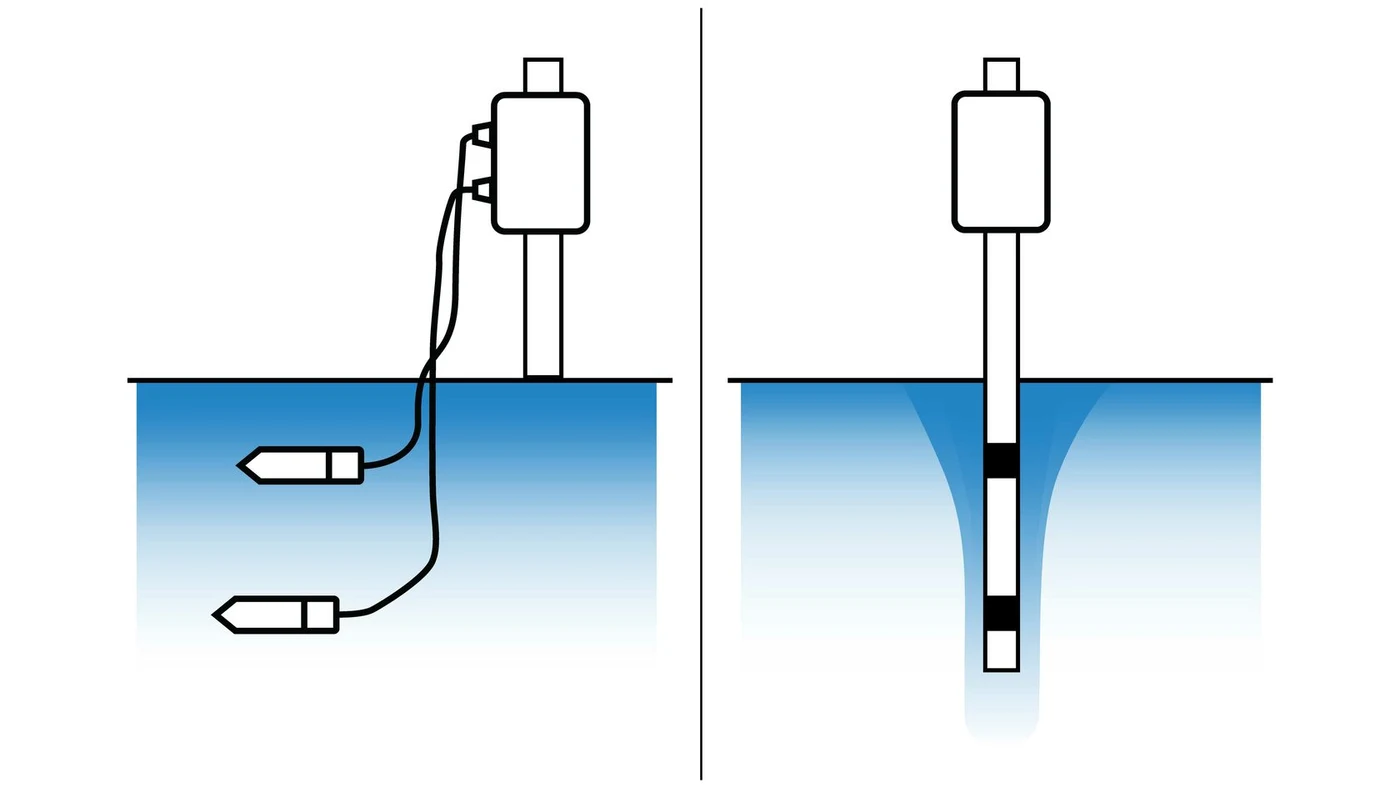
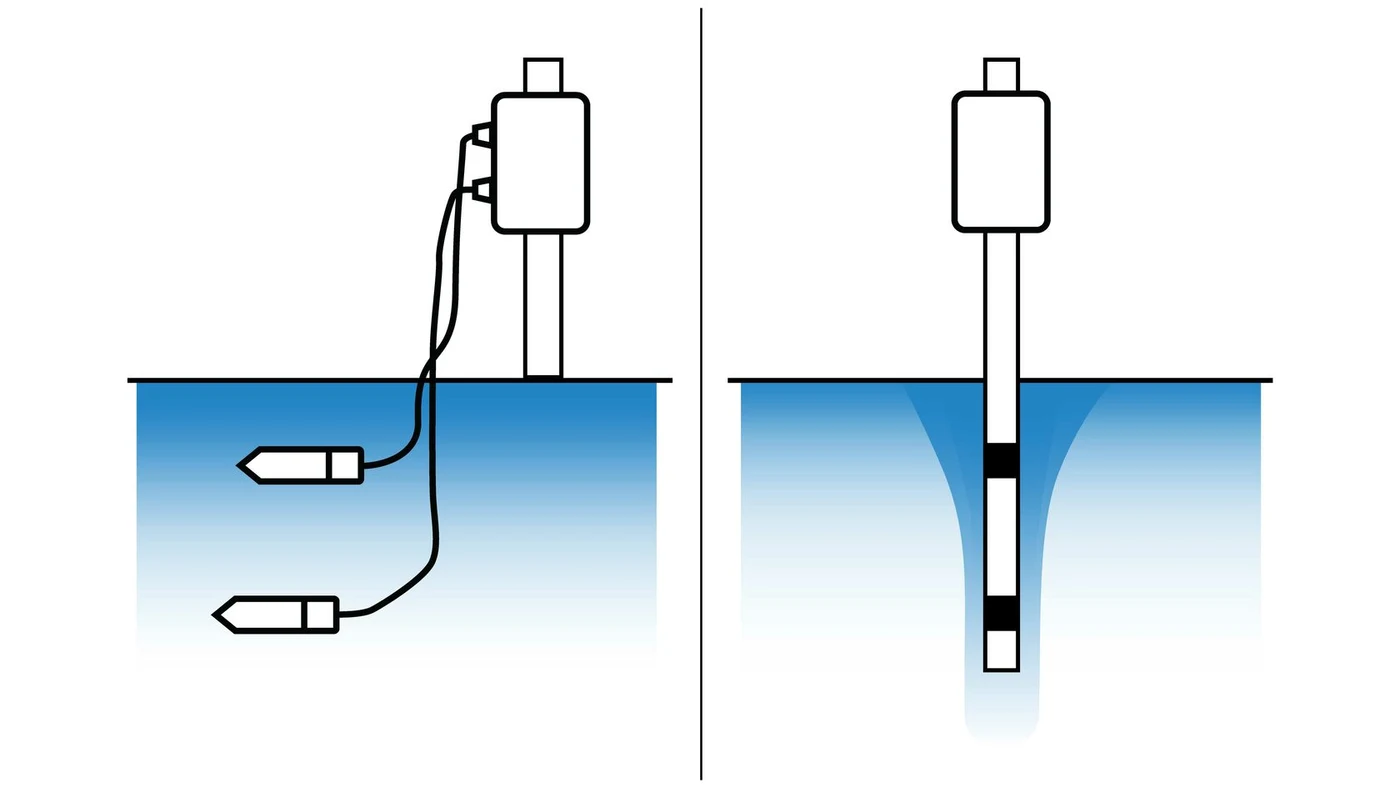
This is the big one. When water can't move uniformly through soil and instead races along a preferred path, soil scientists call it preferential flow. A probe inserted vertically — or an access tube — is a ready-made preferred path. Rain and irrigation run down the device's own surface, or down the loosened backfill around it, faster than water moves through the surrounding field.
The consequence is subtle and costly: the probe reads wetter than the soil your crop is actually rooting in. It reports the little wet sleeve around itself, not the field. And because a soil moisture system builds everything else on top of that number — field-capacity detection, refill timing, the water budget — a high bias at the sensor propagates into every decision downstream. You irrigate late because the gauge says there's water that isn't there.
Research on access-tube installations has put numbers on it. A USDA-ARS synthesis reports volumetric-water-content errors above 0.05 m³/m³ (roughly ±5% VWC) for capacitance sensors in access tubes, implying irrigation-flux estimation errors of up to 50 mm/day from this effect (Evett et al., 2012). Even manufacturers of access-tube probes flag it in their own installation guidance and require sealing techniques to fight it (see METER Group, below).
Risk 2: A tiny measurement volume — in the worst possible place
Every sensor only "sees" a certain volume of soil around it. For the capacitance and FDR (frequency-domain) probes common in low-cost drop-in systems, that sensing volume is small and heavily weighted to the first few centimetres right next to the probe or tube wall. In one widely used profile probe, about 90% of the response comes from within roughly 3 cm of the access tube, because most of the electromagnetic field stays confined to the tube itself (Kelleners et al., 2004; Paltineanu & Starr, 1997).
Stack that on Risk 1 and you get the worst of both worlds: the exact zone the probe is most sensitive to — the skin of soil against its surface — is the same zone most corrupted by preferential flow, disturbance, and any gap or film at the wall. A profile probe with a small support volume in a disturbed sleeve is, in effect, measuring its own installation rather than the field. Researchers have made the point directly: small measurement volumes leave these systems "susceptible to small-scale variations in soil water content … and to soil disturbance close to the access tube caused during installation" (Evett, Tolk & Howell, 2006). A larger, well-coupled sensing volume in undisturbed soil is far harder to fool.
Risk 3: Air gaps and imperfect soil contact
Electromagnetic soil sensors assume the soil is pressed firmly against the sensing surface. Insertion and access-tube designs make that hard to guarantee. Pushing a shaft in can smear and compact one side and leave voids on the other; access tubes rarely mate perfectly to an augered hole; and in shrink–swell clays the soil pulls away from the tube every time it dries, opening an air gap. The direction of the error flips with what fills the gap: an air-filled void around an access tube biased readings low, while a water-filled void biased them high — measured shifts of −0.068 and +0.080 m³/m³ in one controlled study (Bagnall et al., 2018).
This is exactly why serious access-tube systems specify a soil-slurry installation — you pour a slurry around the tube to eliminate the gap. It works, but it's a technique, not a given, and university extension guidance warns that if the slurry is too thin it cracks as the soil dries, "creating air gaps and preferential water flow" (Lena et al., 2021). It's the opposite of "drop-in." A blade or plate pressed sideways into the firm, undisturbed wall of a small hole gets full contact along its whole face without any of that ritual.
Risk 4: One point is a guess about the whole field
Soil moisture is one of the most spatially variable things in a field — it changes over centimetres, not just metres. A single probe samples a tiny support volume, and the measurement-scale literature is explicit that the "support" of a point sensor (the volume it integrates over) rarely matches the field or root-zone scale you actually want to manage (Vereecken et al., 2008). Variability only grows as you zoom out to the area a probe is meant to represent (Famiglietti et al., 2008).
This isn't unique to drop-in probes, but it compounds their other problems: if a point measurement is already fragile, you really don't want the point itself biased by its own installation. The practical answer isn't "a probe in every corner." It's placing a representative set per management zone — by soil type and irrigation valve — and making sure each of those points is reading the soil, not an artifact of how the sensor went in.
Risk 5: Calibration drift, salinity, and temperature
Sensor physics sets the ceiling on everything above. In peer-reviewed field comparisons, TDR- and TDT-class sensors sit in the tightest accuracy band, and they hold up as soil salinity rises. Capacitance / FDR / ADR sensors — the class most drop-in probes fall into — are cheaper and mature, but they typically need soil-specific calibration to be trustworthy: they overestimate water content as salinity climbs and are more sensitive to temperature and texture, so factory calibration alone can carry errors of several percent VWC in the field (Qi et al., 2024; Vaz et al., 2013). A "smart" platform on top of a probe like that is a clean interface over noisy data — and irrigation decisions are most sensitive to exactly that noise.
A geometry that sidesteps the problem
Notice that Risks 1–3 are not really about the electronics — they're about geometry and installation. So the honest fix isn't "buy a smarter probe," it's "put the sensor in the ground in a way that doesn't create the failure modes in the first place."
That's the design choice behind SoilSense. Instead of a shaft dropped into an augered hole or a rod in an access tube, SoilSense uses flat blade sensors pushed sideways into the firm, undisturbed wall of a small hole. The sensor meets untouched soil along its whole face, at one clean depth:
- No vertical device surface for water to run down, and no backfilled column — so the main preferential-flow path is gone.
- Full soil contact along the blade without a slurry ritual — so there's no air gap to under-read.
- The sensing volume sits in undisturbed soil, not a disturbed sleeve — so it measures the field, not the installation.
On the physics side, SoilSense uses TDT (Time Domain Transmissometry) — the same research-grade class as TDR — which stays stable in the heavy, salty soils that pull capacitance probes off calibration.
To be fair about the trade-off: if what you need is a deep, multi-metre soil profile at six or more depths, a purpose-built access-tube system like Sentek's Drill & Drop is still the established tool, and the slurry install is part of doing it properly. For root-zone irrigation decisions on a working farm, though, the buried-blade geometry avoids most of the risks above by construction rather than by careful technique.
What the research says
The risks above aren't marketing claims — they're documented across decades of soil-physics and sensor literature. A curated, verifiable selection, grouped by the risk each one backs (every quote is from the source itself):
Preferential flow down the probe and access tube
- Evett, S.R., Schwartz, R.C., Casanova, J.J. & Heng, L.K. (2012). Soil water sensing for water balance, ET and WUE. Agricultural Water Management 104:1–9. — "Studies consistently showed errors up to and >0.05 m³ m⁻³ for capacitance sensors used in access tubes, which implied errors in soil water flux estimation of up to 50 mm day⁻¹…" doi.org/10.1016/j.agwat.2011.12.002
- Jarvis, N.J. (2007). A review of non-equilibrium water flow and solute transport in soil macropores. European Journal of Soil Science 58:523–546. — "Pores larger than c. 0.3 mm in equivalent cylindrical diameter allow rapid non-equilibrium flow. Apart from their large size and continuity, this is also due to the presence of impermeable linings and coatings that restrict lateral mass exchange." doi.org/10.1111/j.1365-2389.2007.00915.x
A small measurement volume, right at the probe surface
- Kelleners, T.J., Soppe, R.W.O., Robinson, D.A., Schaap, M.G., Ayars, J.E. & Skaggs, T.H. (2004). Calibration of Capacitance Probe Sensors using Electric Circuit Theory. Soil Science Society of America Journal 68(2):430–439. — "90% of the sensor's response is obtained from a zone that stretches from about 3 cm above and below the center of the plastic ring to about 3 cm in radial direction… The presence of the access tube therefore clearly limits the measurement volume of the sensors." doi.org/10.2136/sssaj2004.4300
- Paltineanu, I.C. & Starr, J.L. (1997). Real-time Soil Water Dynamics Using Multisensor Capacitance Probes: Laboratory Calibration. Soil Science Society of America Journal 61(6):1576–1585. — "Axial and radial sensitivity studies showed that these capacitance sensors give integrated readings over a primary depth interval of 10 cm and a radial capacitance fringe within 10 cm of the wall of the access pipe." doi.org/10.2136/sssaj1997.03615995006100060006x
- Evett, S.R., Tolk, J.A. & Howell, T.A. (2006). Soil Profile Water Content Determination: Sensor Accuracy, Axial Response, Calibration, Temperature Dependence, and Precision. Vadose Zone Journal 5(3):894–907. — "…small measurement volumes generally, and suggesting that these systems may be susceptible to small-scale variations in soil water content… and to soil disturbance close to the access tube caused during installation." doi.org/10.2136/vzj2005.0149
Air gaps and imperfect soil contact
- Bagnall, D.K., Crespo Gutierrez, P.M., Yimam, Y.T., Morgan, C.L.S., Neely, H.L. & Ackerson, J.P. (2018). Effect of Air- and Water-Filled Voids on Neutron Moisture Meter Measurements of Clay Soil. Vadose Zone Journal 17(1):180137. — "Air- and water-filled voids from larger annuli were significantly lower and higher… than core-measured θ, with biases of −0.068 and 0.080 m³ m⁻³, respectively." doi.org/10.2136/vzj2018.07.0137
- Lena, B.P., Morata, G.T. & Ortiz, B.V. (2021). Installation of Soil Sensors for Irrigation Scheduling. Alabama Cooperative Extension System (ANR-2775). — "Air gaps are one of the main driving factors resulting in inaccurate soil water levels." aces.edu
- Pečan, U., Zupanc, V. & Pintar, M. (2021). Methods for measuring soil water content. Acta agriculturae Slovenica 117(2). — "Special attention is required when installing the sensors, as the presence of air gaps causes errors in the measurements." doi.org/10.14720/aas.2021.117.2.1618
One point vs. the whole field
- Vereecken, H., Huisman, J.A., Bogena, H., Vanderborght, J., Vrugt, J.A. & Hopmans, J.W. (2008). On the value of soil moisture measurements in vadose zone hydrology: A review. Water Resources Research 44:W00D06. — "…a scale triplet that applies both to models and measurements: spacing, extent and support… support [refers] to the integration volume or area." doi.org/10.1029/2008WR006829
- Famiglietti, J.S., Ryu, D., Berg, A.A., Rodell, M. & Jackson, T.J. (2008). Field observations of soil moisture variability across scales. Water Resources Research 44:W01423. — "Variability of soil moisture is known to increase with the size of the spatial domain within which soil moisture measurements are taken, which is referred to as the 'extent' scale." doi.org/10.1029/2006WR005804
Calibration, salinity, and temperature
- Qi, Q., Yang, H., Zhou, Q., Han, X., Jia, Z., Jiang, Y., Chen, Z., Hou, L. & Mei, S. (2024). Performance of Soil Moisture Sensors at Different Salinity Levels: Comparative Analysis and Calibration. Sensors 24(19):6323. — "The measured soil moisture values from various sensors exhibited varying degrees of overestimation, which increased with increasing salinity… each sensor type should be specifically calibrated for different soil salinity levels instead of applying factory calibration formulas." doi.org/10.3390/s24196323
- Vaz, C.M.P., Jones, S., Meding, M. & Tuller, M. (2013). Evaluation of Standard Calibration Functions for Eight Electromagnetic Soil Moisture Sensors. Vadose Zone Journal 12(2). — "…lower frequency sensors are less expensive but more sensitive to confounding effects of salinity, temperature, and soil textural variations." doi.org/10.2136/vzj2012.0160
The manufacturers acknowledge it too
- Campbell, C. (2017). Soil Moisture Sensors: Which Installation Method is Best? METER Group (Environmental Biophysics). — "The profile probe is also especially susceptible to preferential-flow problems down the long surface of the access tube… All dielectric probes are most sensitive at the surface of the probe." environmentalbiophysics.org
The bottom line
A soil moisture probe's data is only ever as good as the soil it's actually reading. Drop-in designs trade a few minutes at install for a set of measurement risks — preferential flow, a small and badly placed sensing volume, air gaps, calibration drift — that the soil-physics literature has documented for years. You can manage some of them with careful installation. Or you can pick a geometry that doesn't create them in the first place.
Either way, the question to put to any vendor is the same one that separates a research-grade measurement from a good-looking dashboard: how does your probe sit in the ground, and what is it actually measuring?
Next: the ten questions to ask before you buy a soil moisture sensor, a plain-language overview of sensor technologies, or the full comparison of wireless soil moisture systems.
Ready when you are
Talk to SoilSense — free
A 30-minute consultation, no commitment. We'll help you decide whether SoilSense is a fit for your operation.