
Lesson A
Pick the right sensor — without the jargon
Before any data can help you, you need the right tool in the ground. The good news: choosing a soil moisture sensor comes down to a handful of simple questions. Let's walk through them.
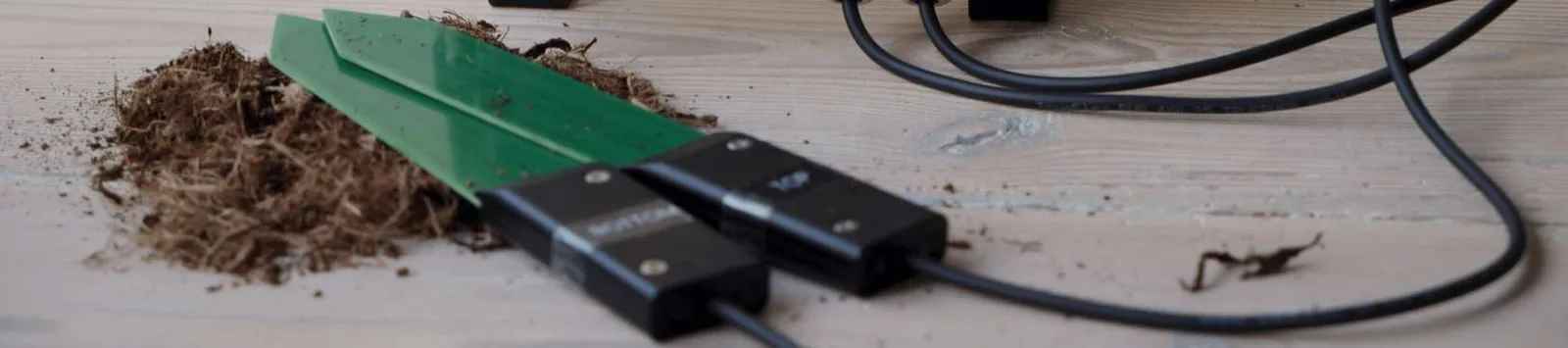
What a soil moisture sensor actually does
A soil moisture sensor measures how much water is in your soil, right at the roots, all day long. Instead of digging a hole or squeezing a handful of soil, you get a continuous reading you can see on your phone.
Most modern sensors report Volumetric Water Content (VWC) — simply the share of the soil that is water, shown as a percentage. We'll turn that into something even easier in Lesson D.
The two ways to measure — and why VWC wins
There are two families of sensors. One measures how much water is in the soil — volumetric water content, or VWC. The other measures how hard the roots must pull to get it — matric potential, or tension. Both are valid science, but for day-to-day irrigation VWC is the clearer, sturdier choice, and it's what SoilSense uses.
Tension tells you the soil is "thirsty" but not how much water to add, and the common tensiometer loses its suction once the soil dries past a point — going blind exactly when the crop is under stress. VWC sidesteps both problems: it reads like a fuel gauge across the full range, and SoilSense's TDT probes stay stable even in the heavy, salty soils that fool cheaper sensors.
Upkeep is the quiet difference. A tensiometer is a maintenance habit — its water column has to be topped up and its seal kept good, or the readings drift and then fail. A solid-state VWC probe has nothing to refill and nothing to re-seal, so it runs a full season untouched in the ground. Less to remember is less to go wrong.
- Easy to readVWC is "how full is the tank," and it tells you how many millimetres to add to refill it.
- Reliable wet to dryVWC keeps reading even in dry soil, where tensiometers lose suction and stop reporting.
- Low upkeepsolid-state sensors, with nothing to refill or re-seal across a long season.
- Tension still has its place — it reflects crop stress directly — but it's more abstract and narrower in range, so VWC is the better default.
Two ways to measure the same water
How much water
Volumetric (VWC) — read it as how full the tank is.
How hard to pull
Tension — how tightly the soil grips what's left.
How deep, and how many?
Put sensors where the roots are. For most crops that means at least two depths — a shallow one where the crop drinks first, and a deeper one to catch water moving past the roots. Together they tell you when you've watered enough, and when you've watered too much.
A third depth in between earns its place when the root zone is deep or uneven, when the soil changes texture as you go down, or when a high-value crop makes it worth seeing exactly where each irrigation stops. That middle reading pins down the wetting front — proof that water reaches the productive roots without draining straight past them. With up to five sensors on one SoilSense datalogger, there's room to add it.
Some growers and researchers go further still — six, seven, or more levels stacked every 10 cm down a metre or more. That near-continuous profile suits deep-rooted perennials in deep soils, or formal water-balance studies that account for every millimetre; it's far more resolution than routine irrigation needs, and a specialist tool. For most fields, two or three well-placed depths in the active root zone answer the only question that matters: water now, or wait. And you don't need a sensor in every corner — one representative set per irrigation zone manages the whole zone.
- Two depths — the reliable default: timing up top, wetting front below.
- A third depth — for deep or layered root zones, high-value crops, or pinning down exactly where each irrigation stops.
- Six or seven levels — a near-continuous deep profile for perennials in deep soils or research, beyond what routine irrigation needs.
Two depths tell the whole story
- Shallow sensorWhere the crop drinks first
- Deep sensorCatches water draining past the roots
- Active root zone
Why a blade beats a probe
How a sensor sits in the ground matters as much as where. SoilSense uses flat blade sensors pushed sideways into the firm, undisturbed wall of a small hole, so the sensor meets untouched soil along its whole length at one clean depth.
A round probe dropped into an augered hole and backfilled sits in loosened soil instead. Rain and irrigation then run down that disturbed column faster than they move through the field — that's preferential flow, and it makes the sensor read the hole rather than your crop's real conditions. A horizontal blade sidesteps it, needs no slurry to seat, and samples the layer you actually care about.
- Blade: full contact along its face, one clean depth, nothing to backfill wrong.
- Probe in a hole: loosened soil and a channel for water to race down — preferential flow that misreads the field.
Why a blade beats a probe
Blade, in undisturbed soil
Pushed sideways into the firm wall of the hole, the blade meets untouched soil along its whole length — full contact at one clean depth.
Probe, in a backfilled hole
Dropped into a hole and backfilled, a probe sits in loosened soil. Water runs down that column faster than through the field — preferential flow — so it reads the hole, not your crop.
Do you need salinity or rain measurement?
Two optional extras matter for some farms. A salinity (EC) reading helps if you irrigate with salty water or use a lot of fertigation. A rain gauge tells the system how much free water the sky already gave you, so it doesn't tell you to irrigate after a storm.
If neither is a concern, a standard moisture sensor is all you need to begin.
Power and connection — keep it simple
The best sensor is useless if it stops sending data. Look for solar power and a cellular connection, so there are no wires to bury, no Wi-Fi to reach the back forty, and no batteries to swap mid-season.
- What a soil moisture sensor actually does
- The two ways to measure — and why VWC wins
- How deep, and how many?
- Why a blade beats a probe
- Do you need salinity or rain measurement?
- Power and connection — keep it simple
How SoilSense does it for youSoilSense arrives ready for your field
We pre-configure the sensors, run them on solar with a cellular connection, and offer a salinity-aware probe and a rain gauge when you need them. The probes were independently tested on heavy Vertisol clay by the University of Córdoba through AgrifoodTEF — the soils that are hardest to measure well.
Want to go deeper? These open in a new tab so you keep your place: