
Lesson F
What the numbers tell you to do today
Everything so far leads here: a confident answer to "should I water, and how much?" With the tank, the safe line and the weather in hand, the decision becomes routine.
When to irrigate: watch the line
The rule is simple. While the tank stays above the refill line, do nothing — your crop is comfortable and extra water is wasted. When the moisture drops to the line, that's your cue to irrigate. You're working with the crop's natural rhythm instead of guessing.
How much to apply: refill the tank
Apply enough to bring the root zone back up to full — field capacity — and no more. FAO calls this the depletion: the gap between full and where you are now, measured in millimetres. Refill that gap and you've given the crop a full tank without pushing water past the roots, where it leaches nutrients and wastes money.
Watering little and often, or watering far past full, are the two classic ways to waste water. Refilling to the line, on time, avoids both.
Past full — just drains away and leaches nutrients
Field capacity — full
Where you are now
Look at the week ahead
A good decision also glances at the forecast. If rain is coming, you might wait. If a heatwave is on the way, you might top up a little early. Combining what the soil holds now with what the sky will do next is how the best growers stay one step ahead.
Rain on the way
Hold off — let the sky do the watering.
Heatwave coming
Top up a little early to stay ahead of the demand.
Try the decision tool
Set your crop, soil, how full the tank is, and the weather ahead. The tool gives you the same answer an agronomist would — water now or wait. This is the whole course in one screen.
Apple Trees South-East
Getting dry — time to water.
- Very dry
- Dry
- All good
- Too wet
Should I water today?
Put it all together. Tell the tool your crop, soil, how full the tank is now, and the weather ahead — it gives you the FAO answer: water now or wait, and if so, how much.
How full is the tank now?
62% full
Raw sensor reading
20.1% VWC
Same fullness, different raw number — VWC depends on the soil. Switch the soil type above and watch this reading move while the tank stays exactly as full.
Irrigate today
Apply about 54mm
- Saturated (after heavy rain)
- Field capacity — tank full
- Refill line (FAO safe limit)
- Wilting point — tank empty
How SoilSense does it for you
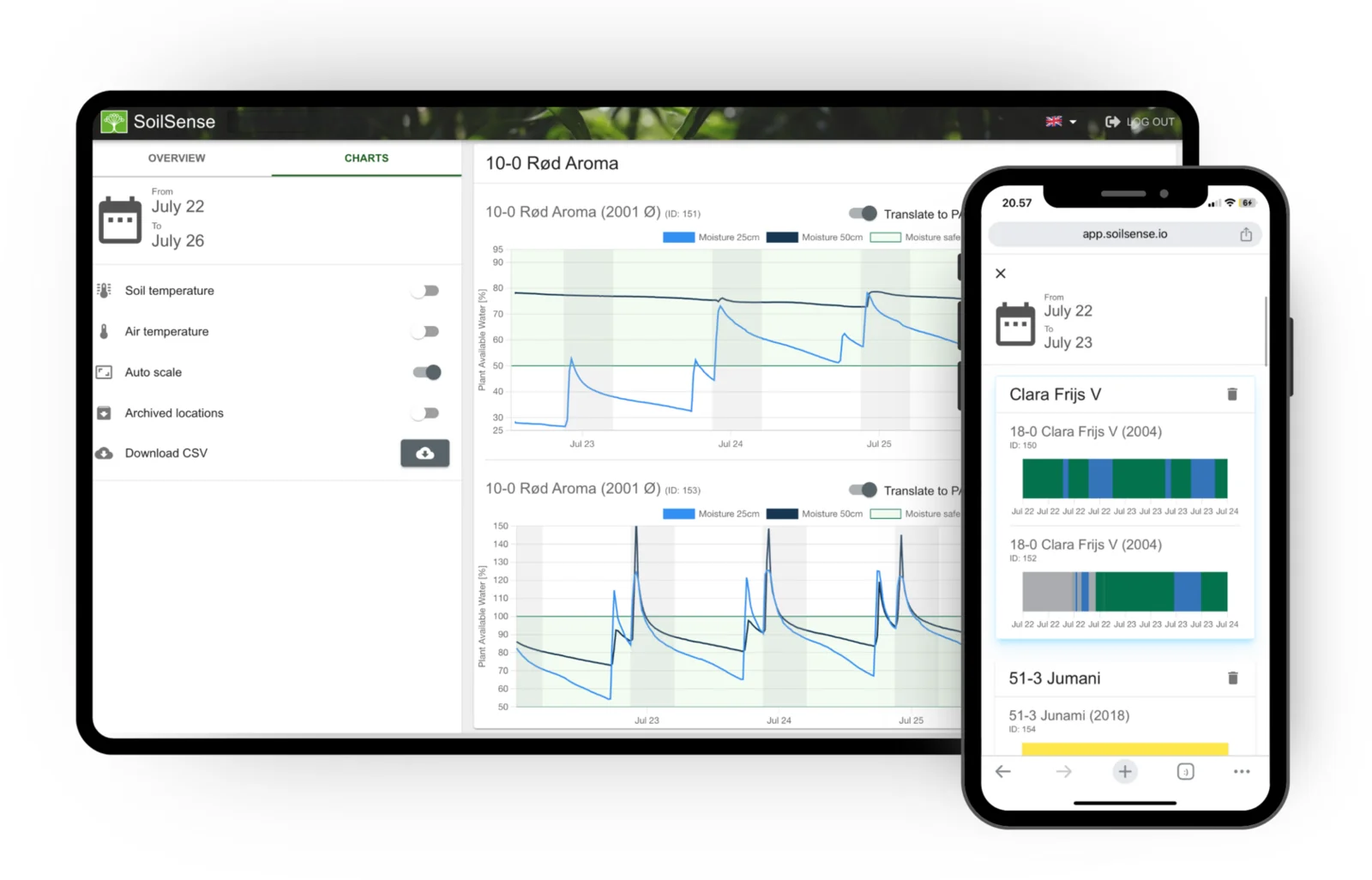
This is exactly the alert SoilSense sends to your phone. Read the colour, follow the number — the science is already done.
Two ways to make the call
The tool runs the FAO method for you — but here's that method in full, so you could keep the books by hand if you ever wanted to.
By hand (the FAO method)
- 1Soak the soil with a good irrigation or rain to fill it.
- 2Wait a day for the extra to drain, then assume the soil is now at field capacity — a full tank.
- 3Each day, work out the crop's water use: ETc = Kc × ET₀. Look up today's Kc for the crop's stage and ET₀ from the weather.
- 4Subtract that day's use from the tank and keep a running total of how far it has dropped.
- 5When the running total reaches the FAO refill line (about half the available water), irrigate back to full — then start the count again. Re-check Kc as the crop grows and ET₀ as the weather turns.
With SoilSense
The sensor reads the water that's actually in the ground every few minutes — so there's nothing to assume and no daily sums to keep. No "is it at field capacity yet?", no looking up Kc and ET₀, no running tally. It shows the colour you just learned and names the day to water. The steps on the left are exactly what it runs for you in the background.
How SoilSense does it for youSoilSense sends you this decision
You've just done by hand what SoilSense does for you continuously. It watches the tank, compares it to the daily safe line, and sends a clear alert: water this field, this much, today — or relax, you're fine. Read the colour, follow the number.

Giuseppe Geresia
Your SoilSense contact
You've finished the course
Let SoilSense do the maths for you
You've seen the science. SoilSense runs it automatically in the background — converting raw sensor readings into a simple colour and a clear recommendation, every day, for every field.