
Lesson E
The safe line moves — and so should you
A fixed watering threshold is a blunt tool. A young crop on a cool day and a full canopy on a scorching one need completely different care. This lesson shows how FAO modelling lets the safe line move with the season and the sky.
Crops drink more as they grow
A crop's thirst changes through the season. Just after planting it uses little water; as the canopy fills in it drinks far more; near harvest it tapers off again. FAO captures this with the crop coefficient, Kc — a number that rises and falls across the four growth stages.
Weather sets the daily pace
The other half is the weather. FAO summarises it as ET₀ — how much water a reference grass would lose today. Hot, dry, windy days have a high ET₀; cool, calm, humid days a low one. Your crop's actual water use for the day is simply its Kc times ET₀.
So a tomato at full canopy on a hot day can drink several millimetres of water, while the same plant on a mild day drinks far less. The tank empties at different speeds on different days.
The refill line moves too
Here's the subtle part FAO gets right: on a high-demand day, a crop feels stress sooner, so the safe refill line rises — you should water at a higher level. On a gentle day, the crop can coast further down. FAO adjusts the safe share of water with the day's demand, so the line breathes with the weather.
Play with the model below: change the crop, its stage and the weather, and watch both the daily water use and the safe line respond.
The safe line moves with the weather
How fast the tank empties depends on the crop's stage and the weather. Change the crop, its growth stage and the day's evaporative demand (ET₀), and watch both the daily water use and the safe refill line shift.
ET₀ is how much water a reference grass would lose today — higher on hot, dry, windy days.
Quick weather
Crop coefficient (Kc)
0.67
Crop water use today (ETc)
−3.3mm/day
Safe refill line
53% full
Drag the point along the curve
- Establishment
- Growing
- Full canopy
- Ripening
On a hot day a crop with a full canopy drinks far more, so the soil dries quickly and FAO tells you to water sooner. On a cool day the same crop can wait longer. A fixed threshold can't keep up — but a moving one can.
- Saturated (after heavy rain)
- Field capacity — tank full
- Refill line (FAO safe limit)
- Wilting point — tank empty
How SoilSense does it for you
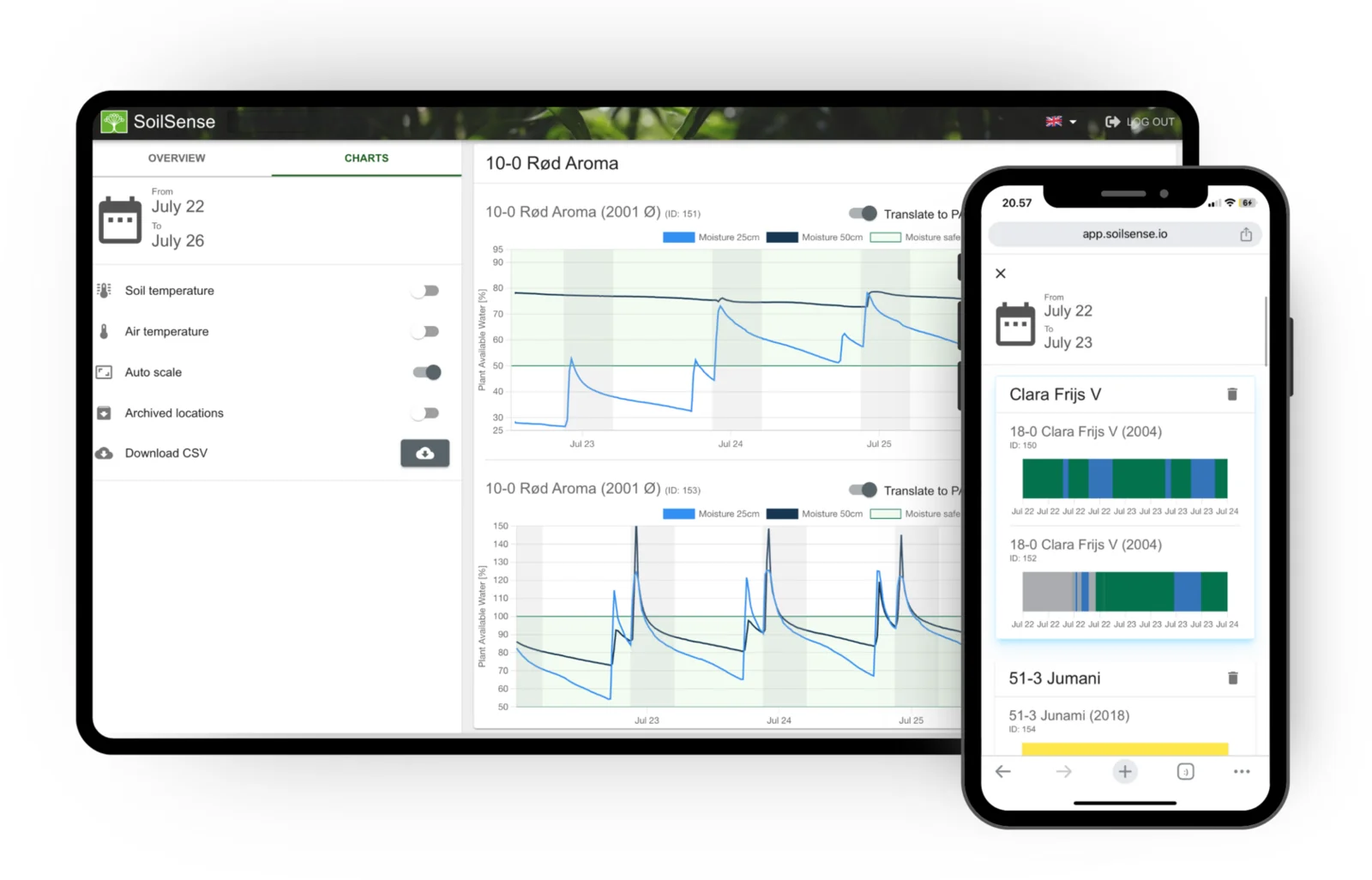
SoilSense recalculates this safe line every single day from your crop's stage and local weather — adaptive thresholds, handled for you.
How SoilSense does it for youSoilSense moves the line for you, every day
This is the part nobody wants to compute by hand — so SoilSense doesn't make you. It recalculates your safe range daily from each crop's growth stage and your local weather, giving you adaptive thresholds that stay right all season long.