
Lesson D
One simple number: how full is the tank?
Here's the lesson that makes everything easy. Instead of juggling moisture percentages and soil types, we squeeze it all into one number from 0 to 100 — and one line that tells you when to act.
The soil-water tank
Think of your root zone as a tank. Rain and irrigation fill it; your crop and the sun empty it. Drag the level to see what the soil is holding — and notice how much easier it is to read as "how full is the tank?" than as a raw moisture number.
Drag the level up and down
72% full
21.4% VWC
Ideal. Plenty of water your crop can easily reach. No need to irrigate.
How SoilSense does it for you
SoilSense draws this exact tank for every field automatically, so you always know how full it is without doing a single calculation.
From a confusing percentage to a clear one
Plant Available Water (PAW) is the water sitting between field capacity and wilting point — the water your crop can actually use. If we call "full" 100% and "empty" 0%, then every field, in every soil, speaks the same simple language.
Now 70% means the same thing everywhere: the tank is well stocked. No more wondering whether 25% is good or bad.
The FAO safe range
You don't want to empty the tank before refilling. FAO research shows each crop can comfortably use a certain share of its available water before it starts to suffer — typically around half. The point where you should refill is called Readily Available Water, and it draws a clear line on the tank.
Stay above the line and your crop never feels stress. Cross it, and it's time to water. It really is that simple.
How much each crop can use before you refill
- Tomato40%
- Maize55%
- Leafy vegetables30%
- Wine grape45%
- Olive65%
- Citrus50%
can use before refilling
Read it as a colour
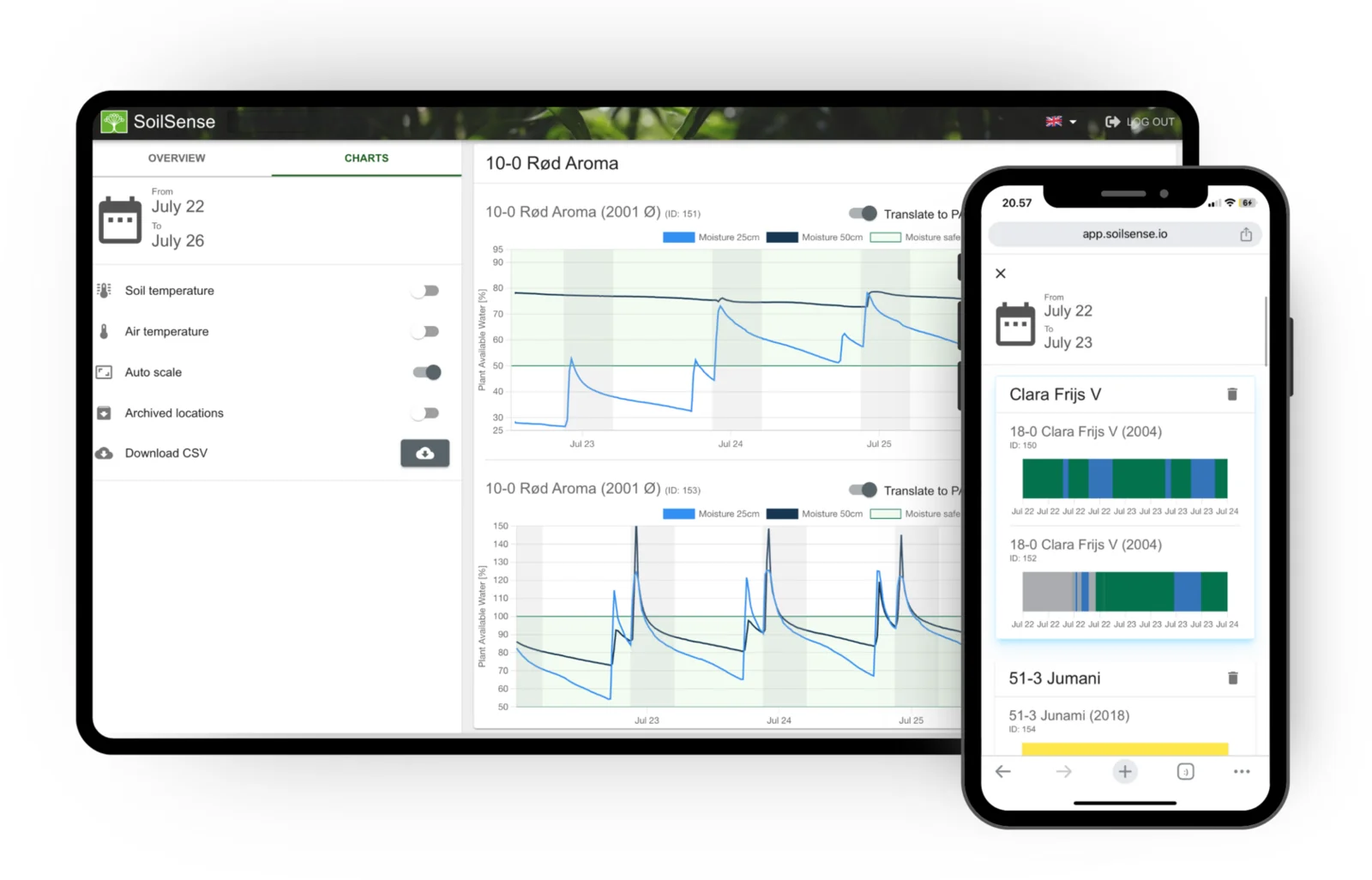
Once you have a full-to-empty number and a refill line, you can read your field as a traffic light — the same colours SoilSense shows: blue when it's too wet to bother, green when all's good, yellow when you've hit the refill line, red when the crop is genuinely thirsty.
How SoilSense does it for youSoilSense gives you the colour, automatically
SoilSense converts raw sensor readings into Plant Available Water for every field and shows you the simple colour you just learned to read. No conversions, no soil tables — just "how full is the tank, and is it time?" The panel below is a live SoilSense view.